
On-site fueling means the fuel comes to your vehicles and equipment where they are parked, instead of your drivers going to a station. In Ontario it takes three forms: wheel-to-wheel fuelling, where each vehicle is filled straight from the delivery truck; tank fills, where a storage tank on your property is topped up; and portable on-site units, which hold a buffer of fuel between visits. Whichever form you use, the delivery is regulated under Ontario's Liquid Fuels Handling Code, which sets out where fuelling can take place and how it must be done. It suits operations whose vehicles come back to the same yard, lot or site most nights. It suits long-haul and cross-province fleets much less well, and you should know which group you are in before you set anything up.

The phrase gets used loosely. In this article, on-site fueling means any arrangement where a licensed supplier brings fuel to the place your vehicles or equipment are kept and dispenses it there. Nobody on your payroll drives to a pump, waits in line, pays with a card or files a receipt. The fuel arrives on a schedule, usually outside working hours, and the vehicles are full when the shift starts.
Ontario's rules call the version where fuel goes directly from a delivery truck into a vehicle mobile fuelling, and they apply to cars, trucks, construction and forestry machines and other off-road equipment alike. That matters because the same safety framework covers a dealership lot, a municipal works yard and a quarry, even though the work looks very different at each.
Most operations use one of three models, and plenty use a mix of them.
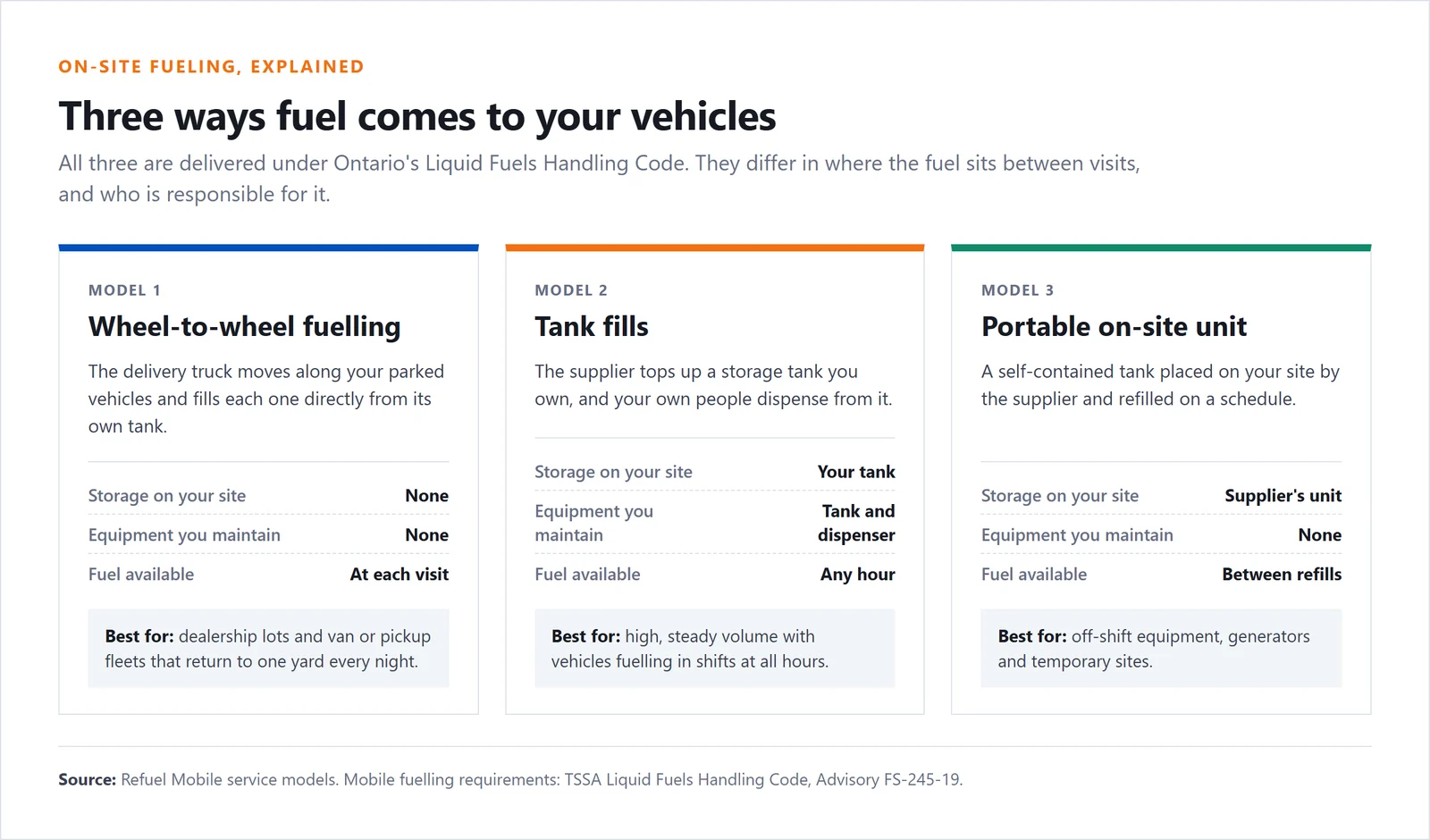
The delivery truck works its way along your parked vehicles and fills each one directly. There is no storage on your site and nothing for you to maintain. It is the natural fit for car dealerships, where inventory has to leave the lot with fuel in it, and for van and pickup fleets that return to one yard every night. We walk through how it runs on a dealership lot in How Ontario Car Dealerships Save 24+ Staff Hours Per Month on Fueling, and our dealership fuel delivery page covers the service itself.
If you already own a storage tank, the supplier keeps it topped up on a schedule and your own people dispense from it. You have fuel on hand around the clock, but the tank, the dispenser and everything that comes with them remain your responsibility. Whether that trade pays off is a bigger question than it first appears, and it gets its own article: Should You Install Your Own Fleet Fuel Tank?
A portable unit sits between the two. It is a self-contained tank that the supplier places on your site and refills, which gives you a buffer for equipment that runs off-shift or for a site that does not justify a permanent installation. On construction sites this is often what keeps generators, pumps and light towers running between visits. Refuel Mobile offers portable on-site units in every area it serves.
The first visit takes the longest, because it is really a survey. After that the routine is short and repeatable.
| Step | What happens | Who handles it |
|---|---|---|
| 1. Site survey | Access, parking layout, clearances, hose routing and where fuelling can legally take place on your property. | The supplier, with your site contact |
| 2. Standing schedule | An agreed recurring window, usually overnight or before the first shift, so no vehicle waits on fuel. | Agreed together |
| 3. Arrival and set-up | Truck positioned clear of property lines, beacon on, extinguisher and spill kit ready, area checked for ignition sources. | The supplier |
| 4. Fuelling | Each vehicle, unit or tank is filled, with the operator at the nozzle for the whole transfer. | The supplier |
| 5. Record | Litres, grade and time logged against the unit number of every vehicle or machine that received fuel. | The supplier |
| 6. Invoice | One consolidated invoice in place of a stack of receipts and card statements. | The supplier |
Once the schedule is running, nobody on your team has to think about fuel until something about the fleet changes.
Ontario regulates mobile fuelling through the Liquid Fuels Handling Code, administered by the Technical Standards and Safety Authority (TSSA). The detail is the supplier's job, but a handful of rules decide what is possible in your yard, so know them before the survey:
Two of these catch people out. The roof-level rule excludes the top deck of a parking structure, which is where some dealerships and property managers would most like to fuel. The property-line rule can exclude a narrow lot where vehicles park tight against the fence. A good survey finds these problems before the first delivery rather than during it. The full rule set, including spill reporting, is covered in Fuelling Heavy Equipment On Site in Ontario.
Very little, in most cases. The practical checklist is short:
If you run a mix of licensed road vehicles and unlicensed off-road equipment, tell the supplier at the start. Off-road equipment can legally run on tax-exempt coloured diesel, which is exempt from Ontario's 9.0 cent per litre fuel tax, but nothing licensed under the Highway Traffic Act can. The two have to be filled from the right grade and recorded separately. Refuel Mobile delivers both on the same visit, and can add diesel exhaust fluid to that visit in every area it serves. Our DEF delivery page explains how that works.
The answer depends far more on how your vehicles move than on what a litre of fuel costs.
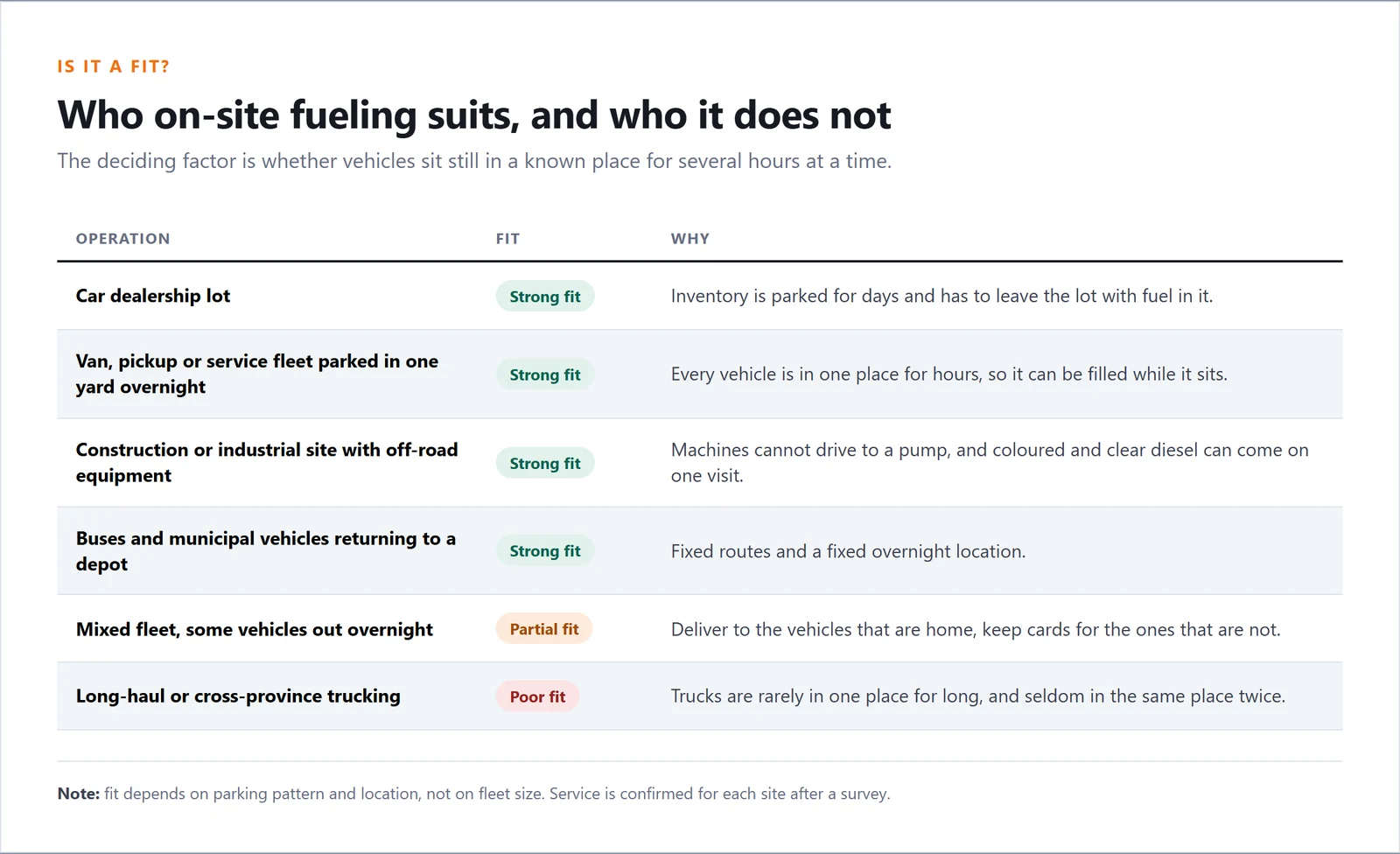
The common thread among the strong fits is that vehicles sit still in a known place for several hours at a time. Where they never do, on-site fueling has nothing to work with, and a card program is probably still the better tool. If you are weighing the two side by side, Fuel Delivery vs Gas Cards runs the comparison, and The Hidden Cost of Cardlock Fuel Cards in Ontario covers the costs that never appear on a card statement.
Construction is a special case. Machines on an active site cannot drive anywhere to fuel, so on-site delivery is less a choice than the only workable option. How Ontario Construction Companies Are Eliminating Fuel Station Runs shows what that looks like over a full project.
Setting up an account takes a conversation, a fleet or equipment list and a site survey. Once the account exists, deliveries can typically be scheduled within 24 to 48 hours, weekdays and weekends. Same-day service is not guaranteed for a new customer, which is one more reason to set things up before you need them rather than on the morning a vehicle runs dry. For fleet-specific detail, see our fleet fuel delivery page.
Book a Yard Survey for On-Site Fueling
Service areas: we deliver across twelve Ontario cities, including Hamilton, Burlington and Oakville. Tell us your yard location and we will confirm coverage.

A better way to get fuel.


© Copyright 2026 ReFuel Mobile™. All Rights Reserved.