
Heavy equipment cannot drive to a gas station, so it gets fuelled where it stands, and in Ontario that is a regulated activity governed by the Liquid Fuels Handling Code. A compliant delivery means minimum 3 metre clearances from property lines and ignition sources, no fuelling on a highway or on the roof level of a building, an operator within arm's reach of the nozzle throughout, a hose no longer than 61 metres, a fire extinguisher and spill kit on the truck, and a written safety and emergency response plan with training records behind it. Get the fuel grade wrong and there is a second exposure: coloured diesel is tax-exempt and legal in unlicensed equipment, and illegal in anything plated under the Highway Traffic Act, with penalties of three to ten times the unpaid tax.
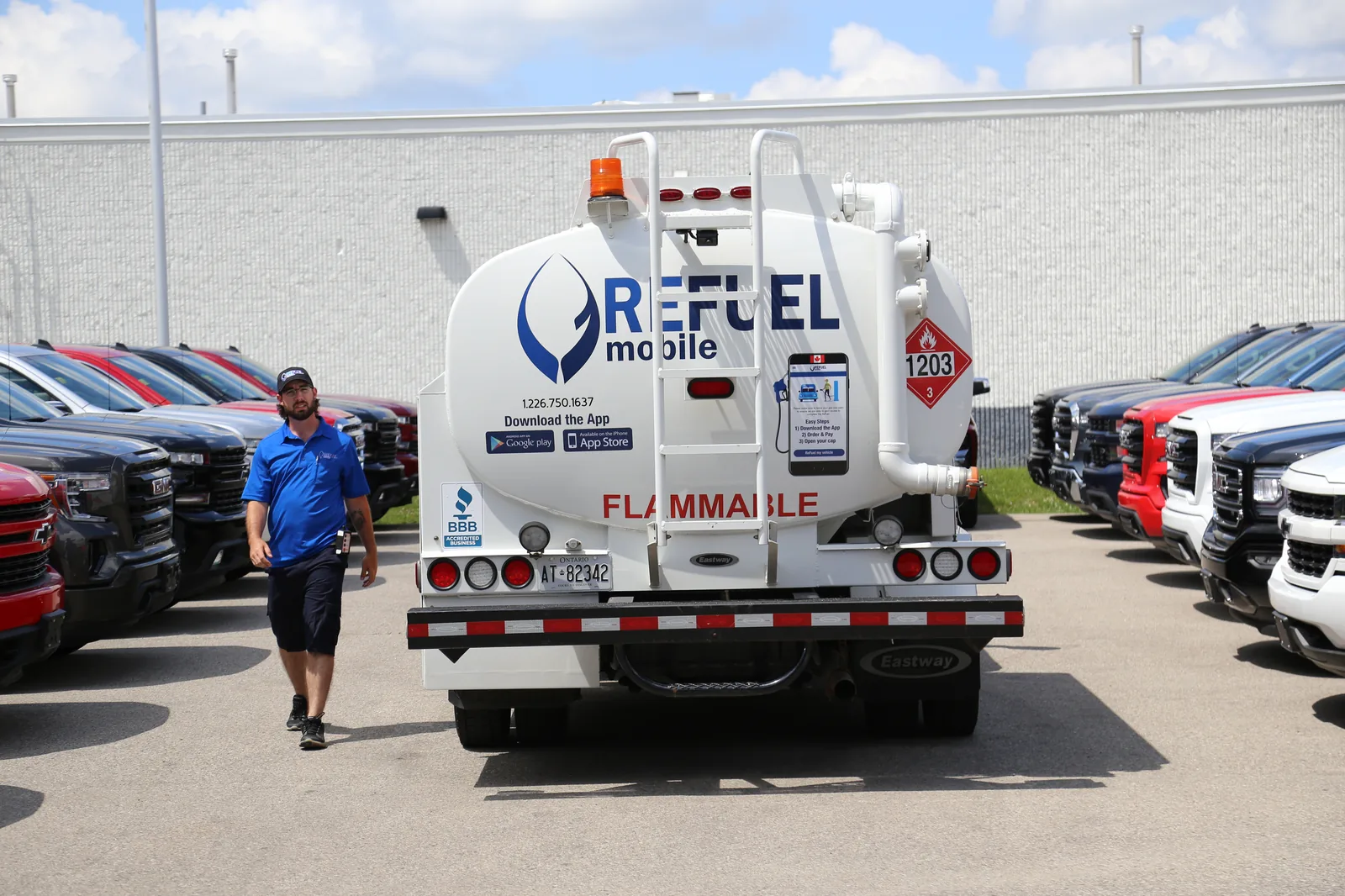
A pickup truck has options. An excavator does not. Once a machine is positioned on a site it generally stays there until the work is finished, which means fuel has to come to it. The same is true of stationary generators, light towers, compressors, crushers, pumps and reefer units.
That single constraint changes everything downstream. It rules out the pump and the cardlock entirely. It puts a fuel transfer inside an active work site with people, traffic and ignition sources around it. And it moves the entire compliance question onto your property, which is why it is worth understanding what the rules actually require rather than trusting that a supplier has it handled.
Ontario's Liquid Fuels Handling Code defines mobile fuelling as dispensing fuel from a highway tank or mobile refuelling tank into a motor vehicle, and it is explicit that this includes construction and forestry equipment and other off-road vehicles. Section 5.8 and the related clauses set out what has to be true on every visit.
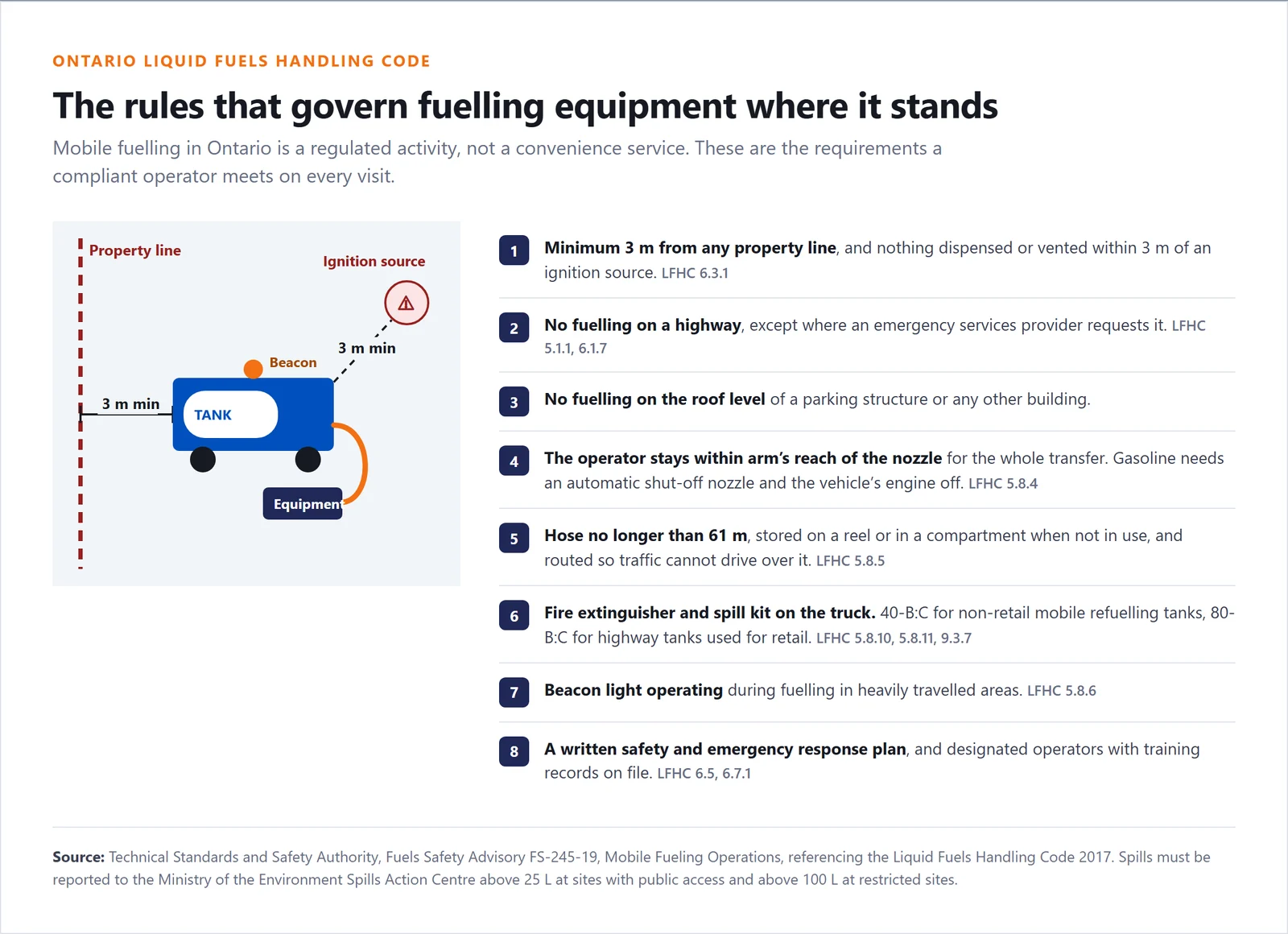
Two of these are worth expanding, because they are the ones most likely to catch a site out. The first is the highway prohibition: fuelling cannot take place on a highway as defined in the code, except where an emergency services provider requests it. If part of your site fronts a public road, where the machine is parked is a compliance question, not a convenience question.
The second is attendance. The operator must remain within arm's reach of the nozzle for the entire transfer. There is no version of a compliant delivery where a hose is left running while somebody does something else. If you have ever seen that on a site, you have seen a supplier cutting a corner that your insurer would want to know about.
For construction sites specifically, TSSA points operators to the Infrastructure Health and Safety Association's procedure for handling fuel on construction sites, which sits alongside the code rather than replacing it.
This is the second compliance exposure on a mixed site, and it is the one that produces assessments rather than incidents. Ontario permits tax-exempt coloured fuel, dyed red with a chemical marker, for prescribed non-taxable uses. It is exempt from the 9.0 cents per litre provincial fuel tax.
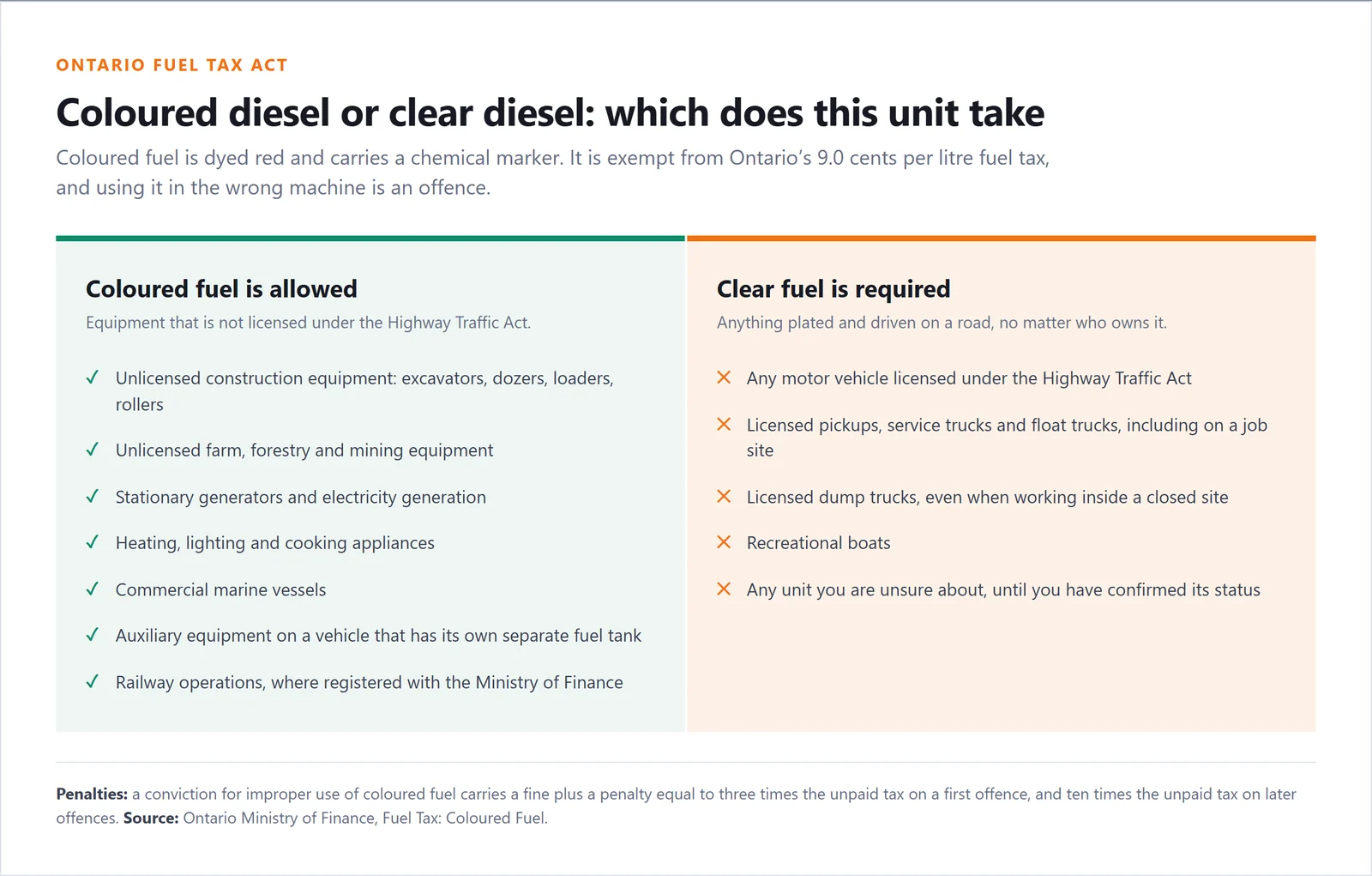
The distinction has nothing to do with where the machine is working and everything to do with whether it is licensed under the Highway Traffic Act. An excavator on a closed site takes coloured fuel. The plated dump truck hauling material out of that same site takes clear fuel, even though it never leaves the property that day. Auxiliary equipment mounted on a licensed vehicle can run coloured fuel only if it draws from its own separate tank.
Only authorised suppliers registered as dyers with the Ministry of Finance may colour fuel, and improper use carries a fine plus a penalty of three times the unpaid tax on a first offence and ten times on subsequent offences. On a site running both grades, the protection is a supplier who delivers both and records each fill against the specific unit, so your own records can demonstrate which machine received which grade.
Spills on a site are the operator's responsibility to control and yours to be aware of. Under Ontario rules, a release of petroleum product must be reported immediately to the Ministry of the Environment, Conservation and Parks Spills Action Centre when it exceeds:
In addition, any release that enters a waterway must be reported regardless of volume, as must any confirmed leak from a mechanical failure of equipment, and any asphyxiation, explosion or fire arising from the use, handling or storage of gasoline or diesel. The Spills Action Centre operates 24 hours a day, seven days a week, at 1-800-268-6060.
This is exactly why the spill kit on the truck is a code requirement rather than a nicety. A contained 15 litre spill is a cleanup. An uncontained one that reaches a storm drain is a reportable environmental incident with your site name on it.
It is also worth understanding that the fuel reached your site under a second set of rules. Diesel and gasoline are dangerous goods in transport, which is why a compliant tanker carries placards and the driver carries the corresponding documentation and training. Transport and handling are governed separately, and a supplier who is casual about one is rarely rigorous about the other.
Six questions, and any competent Ontario operator will answer all of them without hesitating:
The answers matter less than the fluency. A supplier who has to go and find out is a supplier who has not been asked before.
One more thing worth building into your own site procedure: decide in advance where on your site fuelling will take place, and make that the standing location. Choosing it once, with the clearances checked and the hose route agreed, is far better than negotiating it in the dark with a driver who has never been there. It also means a new operator, a substitute driver or a different supplier inherits a location that is already known to work.
| Equipment | What to plan for | Common mistake |
|---|---|---|
| Excavators, dozers, loaders | Position for hose reach and clearance from spoil piles and trenches. Usually eligible for coloured diesel. | Assuming the machine can be repositioned at short notice for the delivery |
| Stationary generators | Runtime remaining and consumption rate drive the schedule. Eligible for coloured fuel. | Treating a generator like a vehicle and topping it up reactively instead of on a threshold |
| Light towers and compressors | Small tanks, high unit count, scattered across the site. Best fuelled on one planned circuit. | Fuelling them individually and reactively, which multiplies visits |
| Reefer units | Cannot tolerate downtime. Needs a firm window rather than a best-effort estimate. | Scheduling reefer fuel around the fleet instead of ahead of it |
| Licensed trucks on site | Clear diesel only, regardless of where they are working. Log separately from off-road units. | Fuelling a plated truck from the coloured tank because it never left the site |
Sites running a mix of these usually get the best outcome from one scheduled circuit rather than reactive calls. That is the model our construction and bulk fuel service is built around, and it pairs with portable fuel units where a site needs on-site storage between visits, which are available across every area we serve.
On a mixed site, coloured and clear diesel can be delivered on the same visit, with each fill recorded against the unit number that received it. That record is what makes the coloured-fuel question answerable after the fact rather than a matter of recollection, and it is the same log you would want in front of you in an audit.
Book a Site Fuelling Assessment
Service areas: we deliver across twelve Ontario cities, including Oakville, Richmond Hill, Thornhill. Tell us your yard location and we will confirm coverage.

A better way to get fuel.


© Copyright 2026 ReFuel Mobile™. All Rights Reserved.