
For most Ontario fleets running 5 or more vehicles or burning more than 1,500 litres of fuel per month, mobile fuel delivery is materially cheaper than gas cards and cardlock once you count driver time, route inefficiency, and reconciliation overhead. A typical 10-vehicle fleet pays roughly $2.30 per litre all-in for gas cards, $1.95 per litre for cardlock, and $1.40 per litre for mobile delivery. That gap (about $23,000 per year for a 10-vehicle fleet) does not show up on any fuel report you currently get. This post explains why, and shows you the math so you can run it against your own numbers.
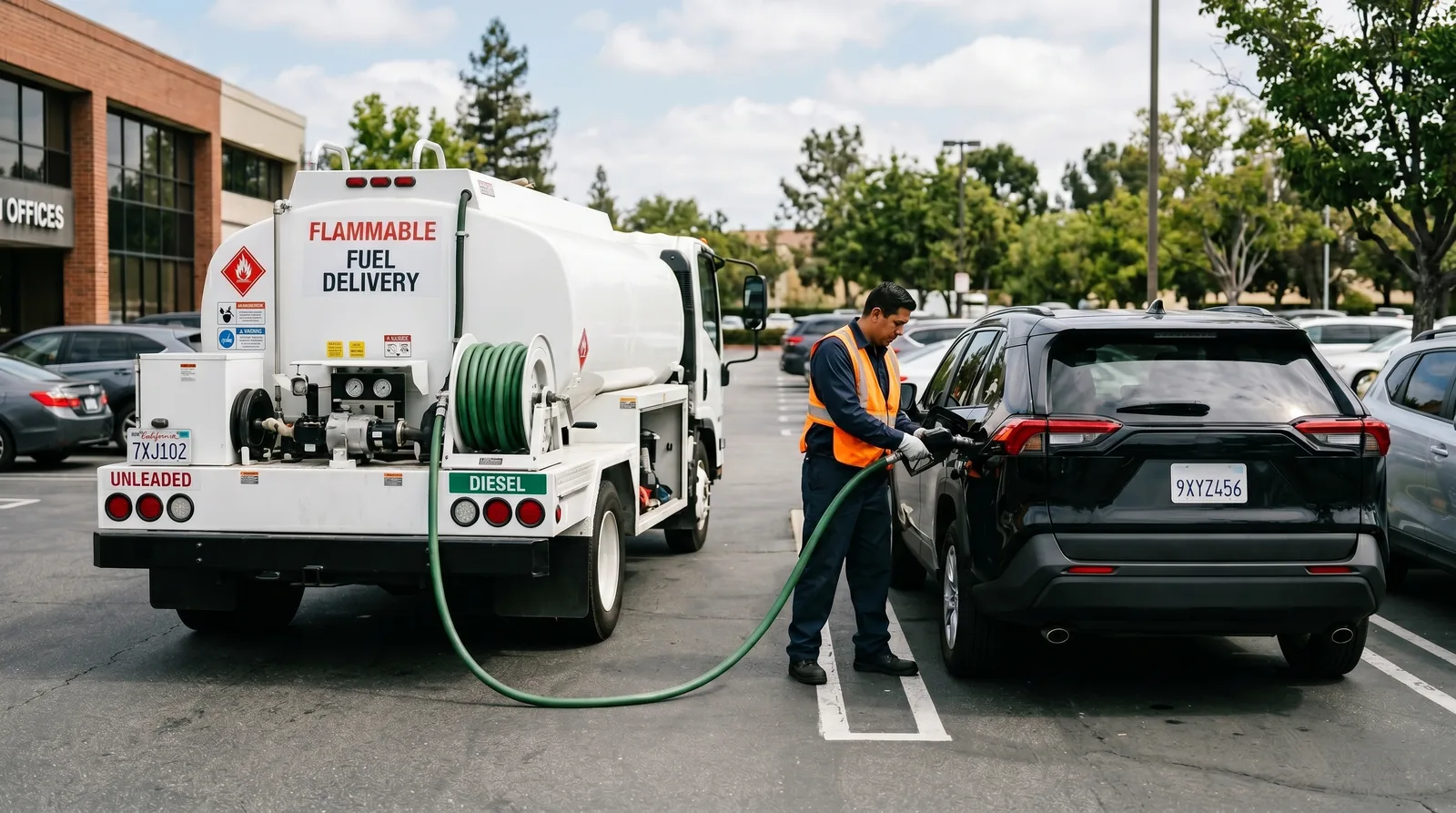
Almost every fleet in Ontario fuels using one of three systems:
All three move litres of fuel into your trucks. The cost difference is not in the litres. It is in everything around the litres.

The pitch on gas cards is simplicity: hand a card to the driver, the driver buys fuel, the card gets billed. No yard, no schedule, no contracts. For a fleet of two or three vehicles, this is genuinely the right answer.
For anything bigger, it gets expensive in five places most fleet managers do not track:
For a 10-vehicle fleet running 5-day operations, those five line items together typically add $15,000 to $20,000 per year on top of the litres-and-cents fuel report your card provider sends you.
Cardlock fixes some of the gas-card problems and creates new ones.
The wins: wholesale-plus pricing (typically $0.10 to $0.20 per litre cheaper than retail), better reporting (per-card transaction logs, volume reporting), and volume contracts that give larger fleets meaningful per-litre discounts.
The losses: cardlock locations are far more limited than retail stations, so out-of-route mileage actually goes up for many fleets (5 to 15 km per fill is common). Card management overhead is real — issuing, deactivating, and managing PINs for a moving driver roster is a part-time job once you cross 20 vehicles. And cardlock margins, while better than retail, still include a profit layer on top of wholesale that mobile delivery does not.
For a 10-vehicle fleet, cardlock typically lands $8,000 to $12,000 per year cheaper than gas cards but still $10,000 to $15,000 per year more expensive than mobile delivery once driver time is counted.
The numbers below assume a representative 10-vehicle Ontario fleet:
Comparison Table
| Cost Line | Gas Cards | Cardlock | Mobile Delivery |
|---|---|---|---|
| Per-litre fuel cost | $1.65/L | $1.45/L | $1.40/L |
| Annual fuel cost (24,000 L) | $39,600 | $34,800 | $33,600 |
| Driver minutes per fill | 20 min | 15 min | 0 min |
| Annual driver hours on fueling | 433 hrs | 325 hrs | 0 hrs |
| Annual driver labour cost | $13,000 | $9,750 | $0 |
| Out-of-route fuel/wear (annual) | ~$1,800 | ~$2,200 | $0 |
| Reconciliation admin (annual) | ~$3,000 | ~$1,500 | $0 |
| Shrinkage / unauthorized | ~$1,500 | ~$500 | $0 |
| Total annual cost | ~$58,900 | ~$48,750 | ~$33,600 |
| All-in cost per litre | ~$2.45/L | ~$2.03/L | ~$1.40/L |
| Annual savings vs. gas cards | — | $10,150 | $25,300 |
The fuel-only line at the top is the only number your current provider shows you. The other six lines are real and they are the reason mobile delivery wins.
Your numbers will vary. Pump prices fluctuate, cardlock contracts vary by volume, and driver-time per fill depends on your route geography. Plug your own assumptions in. The structure of the answer does not change.
Mobile fuel delivery is not the right answer for every fleet. Here is the honest break-even analysis:
For a typical Ontario service-trade, last-mile, municipal, or construction-support fleet, the third profile fits. Which is why we wrote the Fleet Fueling Ontario service page the way we did.
If there is one cost line in the table above that single-handedly decides the gas-card-vs-mobile-delivery question, it is driver labour spent on fueling. The other costs matter, but driver time is the one that compounds invisibly.
A fleet manager looking at a gas-card statement sees $39,600 in fuel for the year. They do not see the $13,000 in paid driver time spent acquiring that fuel. It does not show up on a fuel report. It hides in payroll, where it gets attributed to "drive time" or "shift hours" and never reconciled against the productivity it produced.
Mobile fuel delivery makes that $13,000 visible by reducing it to zero. The fuel arrives while the driver is doing something else (sleeping, on another call, or off-shift entirely). The labour stays in your payroll, but it gets spent on work that actually generates revenue.
That is the actual answer to "what's cheaper." It is not the per-litre price. It is the question of what your drivers are doing during the 433 hours per year they currently spend at gas stations.
You do not have to take our word for any of the numbers above. Run the math yourself:
If mobile delivery does not win on your numbers, gas cards or cardlock might genuinely be the right answer for your operation. If it does win — and for most Ontario fleets above 5 vehicles, it will — then you now have the math that justifies the switch to whoever signs the check.
If your fleet looks like the one in the comparison table, request a quote and we will run the math against your actual numbers.

A better way to get fuel.


© Copyright 2026 ReFuel Mobile™. All Rights Reserved.