
Diesel exhaust fluid is sold at most Ontario truck stops and many retail gas stations in jugs, and through distributors in 208 litre drums and 1,000 litre totes, or delivered in bulk straight into an on-site tank. All four supply the same fluid: 32.5 percent high-purity urea in deionized water, made to ISO 22241. What changes between them is handling time, contamination risk and packaging waste. The thing most operations get wrong is not where they buy DEF but how they store it: at sustained temperatures up to 30 degrees Celsius the fluid carries a minimum shelf life of about 12 months, but at sustained temperatures up to 35 degrees that drops to about six. Jugs sitting in the sun on a loading dock are the most expensive DEF you will ever buy.
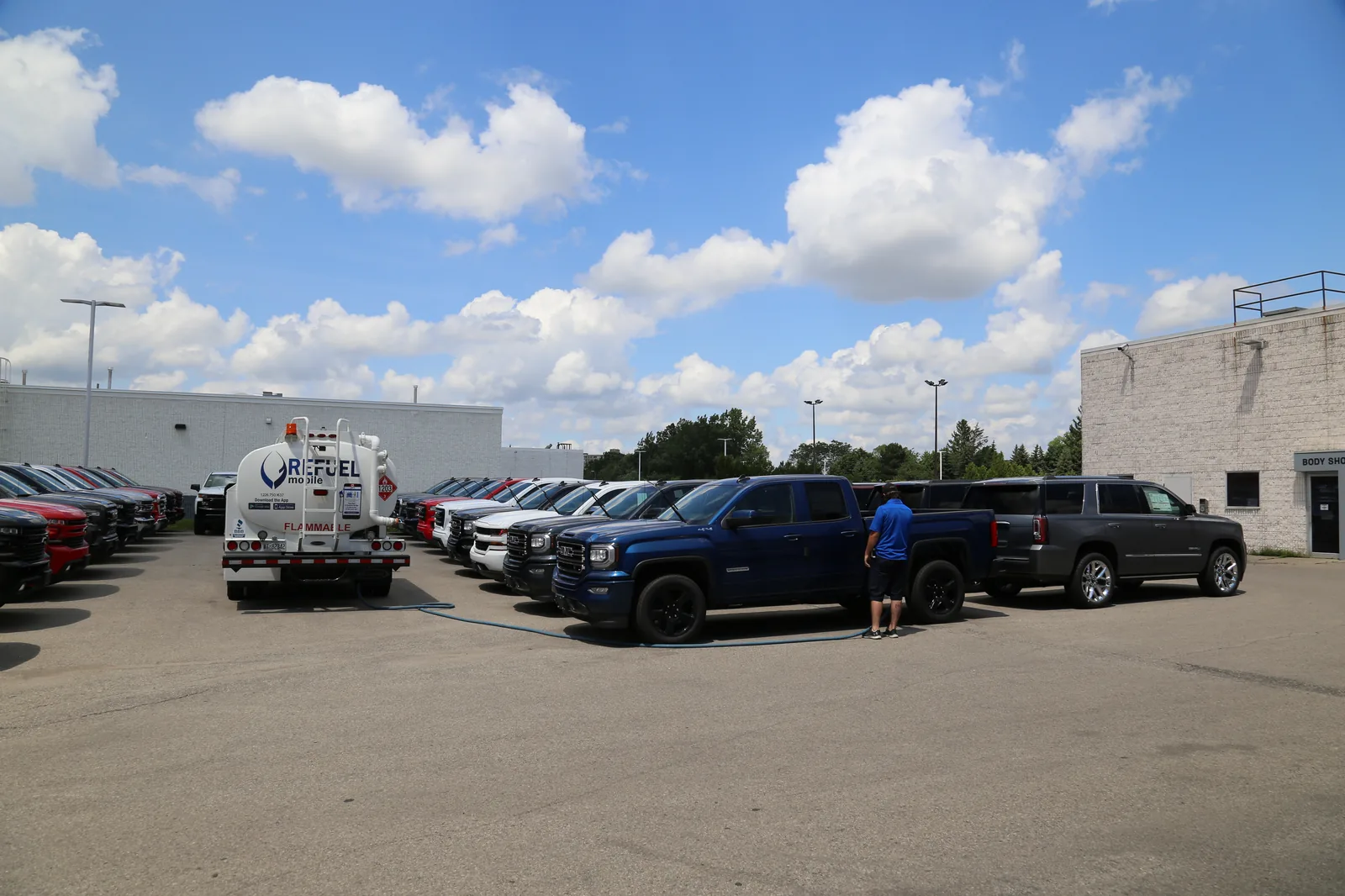
Diesel exhaust fluid is not a fuel additive and it never goes in the fuel tank. It is a consumable that is injected into the exhaust stream of a diesel engine with selective catalytic reduction, where it converts nitrogen oxides into nitrogen and water vapour. Modern diesel engines derate or refuse to start without it.
The fluid itself is deliberately simple: 32.5 percent high-purity urea in deionized water, manufactured to the ISO 22241 specification. That 32.5 percent is not arbitrary. It is the eutectic concentration, the urea-to-water ratio with the lowest possible freezing point. If you want the full background, we cover it in What is DEF? Bulk Diesel Exhaust Fluid Delivery in Ontario.
Yes. Most Ontario truck stops and a large share of retail gas stations stock DEF in jugs, typically 3.78 litre or 9.46 litre containers, on a shelf near the oil and washer fluid. Many truck stops also have DEF available at the pump island alongside diesel, dispensed the same way as fuel.
That is the right answer for a light-duty pickup that consumes a few litres a month. It stops being the right answer surprisingly quickly. A heavy truck working full days gets through DEF steadily enough that jugs become a lot of trips to a shelf and a lot of empty plastic. Once more than a couple of units are involved, the question stops being where to buy DEF and becomes which format to buy it in.
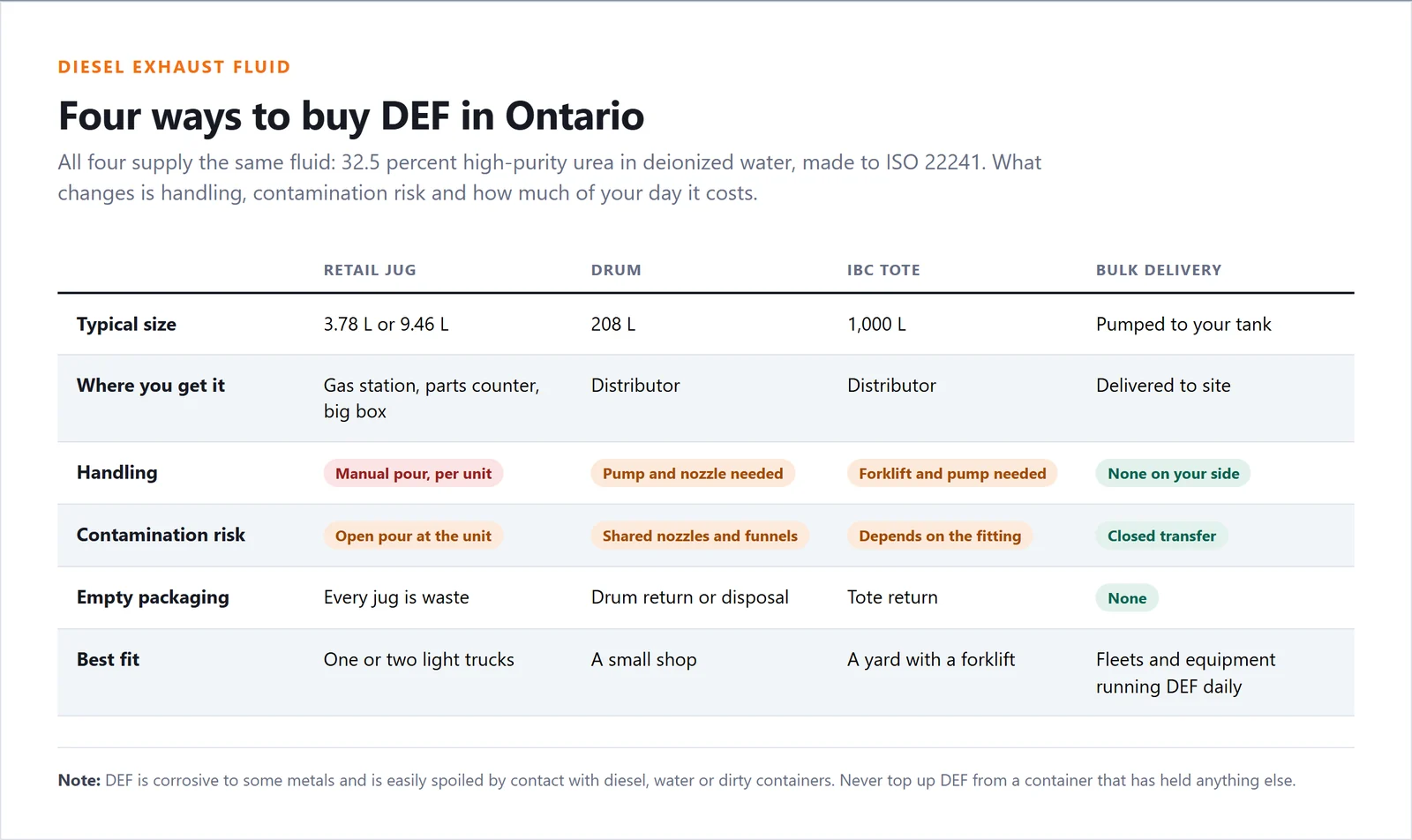
Jugs win on flexibility and lose on everything else. Every fill is a manual pour at the unit, usually outdoors, often in poor light, and every empty is waste you pay to dispose of.
Drums and totes cut the per-litre cost and the trip count, but they move the handling problem rather than removing it. A drum needs a dedicated pump and a nozzle that has never touched anything else. A tote needs a forklift and somewhere clean and temperature-stable to sit. Both need a return or disposal path.
Bulk delivery into a dedicated on-site DEF tank removes the handling entirely. The transfer is closed, there is no packaging, and nobody on your payroll spends time on it. It only makes sense above a certain volume, which is exactly the calculation worth doing before you renew a jug or drum arrangement out of habit. Our DEF delivery page covers how on-site supply works.
DEF is extraordinarily easy to spoil. It is sensitive to dirt, to water beyond its own formulation, to fuel, and to contact with incompatible metals such as copper, brass, zinc and carbon steel. Contaminated DEF does not announce itself. It quietly degrades the SCR catalyst it is supposed to protect, and SCR repairs are a great deal more expensive than DEF.
The practical rules are short:
Purchase format gets all the attention. Storage is what actually determines whether the fluid you bought is still usable when you come to use it.
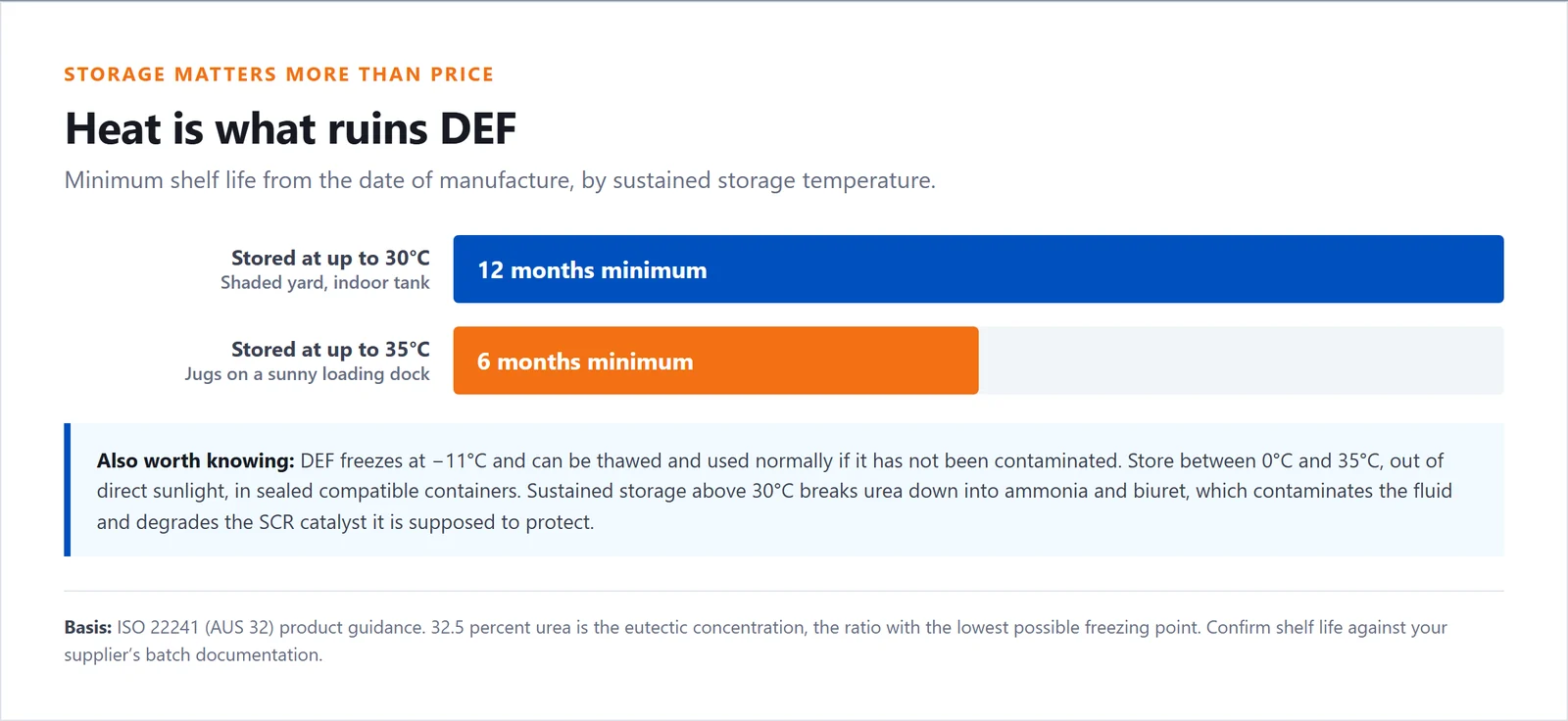
Above roughly 30 degrees Celsius sustained, urea begins breaking down into ammonia and biuret. Both contaminate the fluid, and both degrade the catalyst. An Ontario summer will put a black loading dock or an unshaded steel container well above that for weeks at a time, which is how an operation ends up pouring out-of-spec DEF into new equipment without ever knowing it.
Cold is far less of a problem than heat. DEF freezes at about minus 11 degrees Celsius, which Ontario reaches every winter, but frozen DEF thaws and performs normally provided it was not contaminated before it froze. Vehicle DEF tanks are designed with heaters for exactly this reason. The storage rule is simply: keep it between 0 and 35 degrees, out of direct sunlight, in sealed compatible containers, and buy in volumes you will actually consume inside the shelf life.
Out-of-spec DEF looks almost exactly like good DEF, which is why so much of it gets used. There are a few signals worth training people to notice:
The definitive check is a refractometer, which reads urea concentration directly and costs less than an hour of a technician's time. Anything meaningfully off 32.5 percent is out of specification. If you are running bulk or tote storage, testing on delivery and again before a long storage period is a reasonable discipline, and it also gives you a record if you ever need to raise a quality issue with a supplier.
Sizing matters more than most operators expect, because DEF is one of the few consumables where buying too much at once is a real risk rather than a saving. Shelf life is measured from the date of manufacture, not the date you took delivery, so a bulk purchase that takes eighteen months to consume was never a bargain.
The planning sequence is straightforward. Establish your diesel consumption over twelve months. Apply the DEF consumption rate for your engines, which your manufacturer documentation will state. That gives an annual DEF volume. Divide by twelve for a monthly figure, then size your storage so that you turn over the contents comfortably inside the shelf life at the storage temperature you can actually achieve, not the one you would like.
A tank that is too large for your consumption is a slow-motion spoilage problem. A tank sized to roughly a month of use, refilled on a schedule, keeps the fluid fresh and removes the ordering decision entirely. That is the same logic that makes a standing delivery schedule work for diesel, and it is why the two are usually best handled together.
One practical note on that. Refuel Mobile delivers DEF into a tank you already own rather than supplying or installing storage, so the sizing decision above is yours to make, and it is worth settling before you buy a tank rather than after.
Two or more of these and the cost of staying on jugs is no longer the price on the shelf. It is the labour, the waste, the spoilage, and the exposure to a catalyst repair. Fleets already taking on-site fuel delivery can add DEF to the same visit, in every area Refuel Mobile serves, which makes the comparison a good deal simpler.
Get a Bulk DEF Quote for Your Fleet or Yard
Service areas: we deliver across twelve Ontario cities, including Cambridge, Guelph, Burlington. Tell us your yard location and we will confirm coverage.

A better way to get fuel.


© Copyright 2026 ReFuel Mobile™. All Rights Reserved.