
DEF (diesel exhaust fluid) is a 32.5% urea-and-water solution injected into the exhaust of every modern diesel engine to break down NOx emissions. Every Tier 4 Final diesel truck or piece of equipment built since 2010 (on-highway) or 2014 (off-road) needs DEF on roughly a 1:50 ratio against diesel burn — and the engine derates to limp mode if you run out. Most Ontario fleets still buy DEF the most expensive way possible: $15 to $20 jugs grabbed off a truck-stop shelf. Bulk delivery (totes, drums, or direct tank fill) costs roughly half as much per litre, eliminates the driver-detour habit, and removes the contamination risk that turns a $20 jug into a $5,000 SCR catalyst replacement. This post explains what DEF is, what happens when you run out, why truck-stop buying bleeds margin, and how to size a bulk delivery cadence for your fleet.

DEF is not a fuel additive. It does not go in the diesel tank. It goes in a separate, smaller blue-capped tank usually located adjacent to the diesel fill, and it gets sprayed into the exhaust stream after combustion.
The chemistry: DEF is a precise 32.5% solution of automotive-grade urea in deionized water, manufactured to the ISO 22241 international quality standard. When the exhaust passes through the SCR (Selective Catalytic Reduction) catalyst, the DEF reacts with NOx (nitrogen oxides) and breaks them down into nitrogen and water vapor. The result is dramatically lower diesel emissions — which is why every Tier 4 Final and Stage IV diesel engine sold since the regulation took effect requires it.
A few practical facts every fleet manager should know:
This is the part that turns DEF from a paperwork item into an operational priority.
Modern Tier 4 Final engines are programmed to progressively derate as DEF level drops, on a schedule that gives the operator multiple warnings but ultimately makes it physically impossible to keep working without DEF. The progression:
| DEF Level | What the Engine Does |
|---|---|
| 10% remaining | Dashboard warning light + audible alarm |
| 5% remaining | Engine derates to roughly 50% rated power |
| Below 2.5% | Engine derates further, restart restrictions begin |
| Empty | Engine restricted to 5 km/h limp mode until DEF is replenished |
For an over-the-road truck, this means you make it to the shoulder and stop. For a construction excavator, it means the machine sits idle on a critical-path day while a labourer drives to the nearest truck stop with a credit card and a jug. For a standby generator, it means you discover the problem during the outage you were supposed to be covering.
The cost of a DEF run-out event is rarely the price of the DEF. It is the equipment-hour, labour-hour, or schedule-day lost while somebody scrambles to fix the problem. On any site running Tier 4 Final equipment, that cost can clear four figures inside a single shift.
The default Ontario fleet still sources DEF the most expensive way possible: 9.46-litre (2.5-gallon) jugs grabbed off a truck-stop shelf at $15 to $20 each. That works out to roughly $1.60 to $2.10 per litre. Bulk delivery prices in the $0.70 to $0.90 per litre range. The per-litre delta alone is significant.
But the per-litre price is not the only cost the truck-stop habit imposes:
Bulk delivery solves all four problems with one workflow change: the DEF arrives in sealed containers (or pumps directly into your bulk tank), on a cadence sized to your burn rate, with proactive monitoring so you do not get a surprise derate event.
Bulk DEF is sold in a small set of standard formats. The right one depends on your fleet size and operational footprint:
| Container Format | Capacity | Best For |
|---|---|---|
| 208-litre drums | 208 L | Smaller fleets or remote sites with low burn |
| 1,000-litre IBC totes | 1,000 L | Mid-sized fleets and most construction sites |
| Mini-bulk portable units | 500–2,500 L | Short-duration job sites or seasonal operations |
| Permanent on-site bulk tank (direct fill) | 2,000+ L | Larger fleets, yards with predictable high burn |
Direct tank fill is the most efficient configuration once burn justifies it: the delivery truck pumps from a sealed system directly into your tank, contamination-free, with no jugs or totes to handle on either end.
Whatever format you pick, the DEF should always meet ISO 22241 quality with documentation available on request. Anyone selling unspecified or off-spec DEF is selling you a future SCR catalyst replacement.
The math to size a delivery cadence is simple. DEF consumption runs roughly 2 to 3 percent of diesel burn, or a 1:30 to 1:50 ratio depending on engine class. Use the table below as a starting point:
| Monthly Diesel Burn | Estimated Monthly DEF Burn | Recommended Container | Suggested Cadence |
|---|---|---|---|
| Under 5,000 L | Under 100 L | 208 L drums | Monthly |
| 5,000 – 15,000 L | 100 – 300 L | Drums or mini-bulk | Monthly to bi-weekly |
| 15,000 – 50,000 L | 300 – 1,000 L | 1,000 L IBC tote | Bi-weekly to weekly |
| 50,000 – 150,000 L | 1,000 – 3,000 L | Permanent on-site bulk tank | Weekly + scheduled top-ups |
| Over 150,000 L | 3,000+ L | Multi-tank installation | Continuous scheduled delivery |
Quick worked example: A 15-vehicle long-haul fleet burning 100,000 litres of diesel per year burns roughly 2,000 to 3,000 litres of DEF per year, or about 170 to 250 litres per month. That fleet sits in the "drums or mini-bulk" range with a monthly-to-bi-weekly cadence — and currently spends roughly $3,200 to $5,200 per year on DEF if buying jugs versus $1,400 to $2,250 per year on the same volume bought bulk. The savings cover the delivery setup multiple times over.
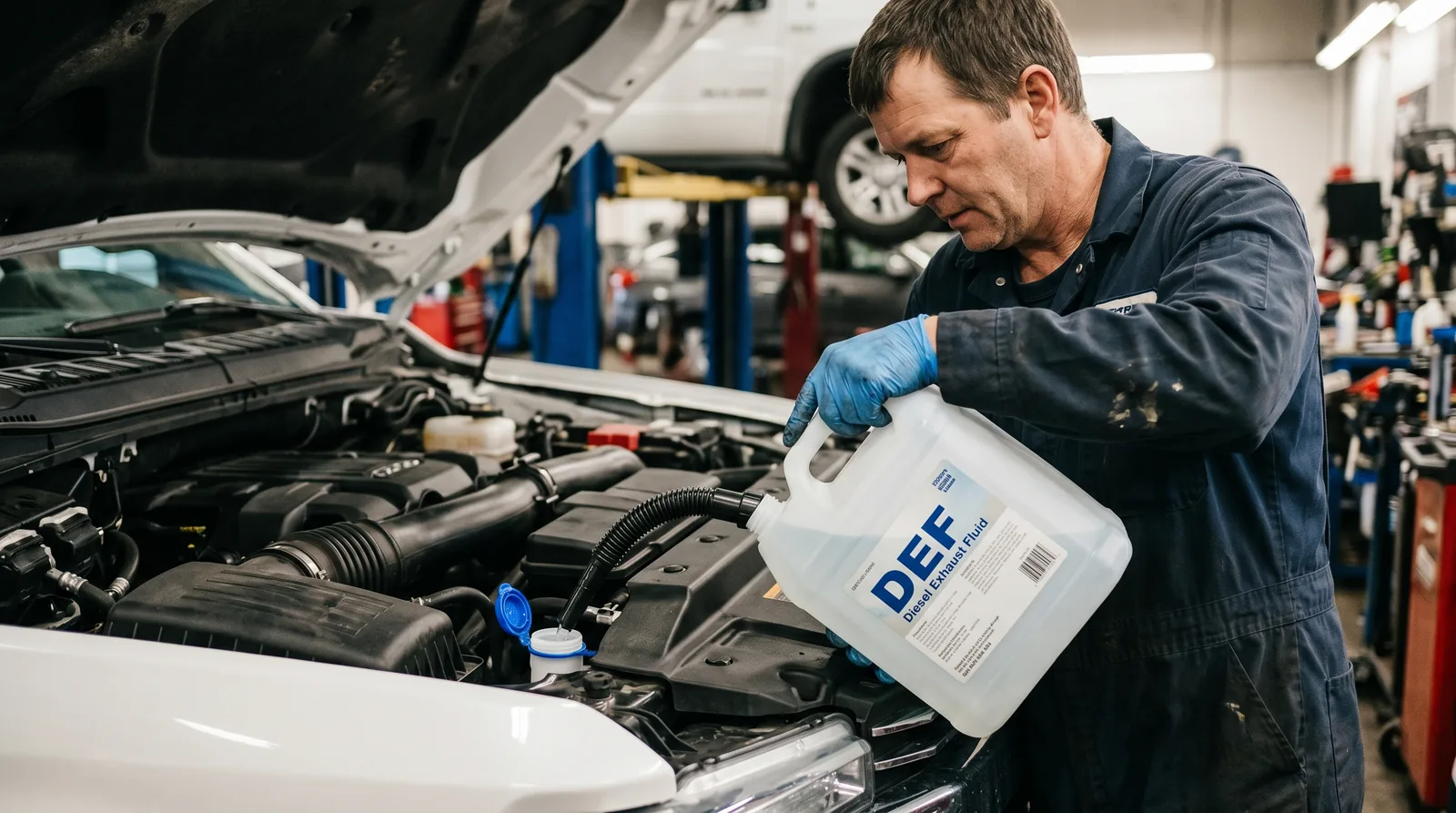
For most Ontario diesel operators, bulk delivery wins on burn rates above roughly 100 litres of DEF per month (which corresponds to roughly 5,000+ litres of diesel burn). Below that threshold, drums or even occasional jug purchases are usually more economical than setting up a delivery cadence.
Above that threshold, the question is not whether to switch to bulk. The question is which container format and which cadence. Both depend on your operational footprint, which a delivery operator should be willing to map for you as part of the quote.
If your fleet runs Tier 4 Final equipment, burns more than 5,000 litres of diesel per month, and is currently sourcing DEF in jugs, you are paying twice for the same litre. The fix is operational, not strategic.
For the full mechanics — container options, ISO 22241 certification, scheduled vs. on-demand cadence, and Ontario service area — read the DEF Delivery Guide.

A better way to get fuel.


© Copyright 2026 ReFuel Mobile™. All Rights Reserved.