
A standby generator is only as reliable as the fuel in its tank, and in Ontario that fuel is regulated in more ways than most building owners realise. The Ontario Fire Code requires emergency power systems to be maintained to CSA C282, to have enough connected fuel to run the engine for at least two hours, and to have their fuel drained and replaced with fresh fuel at least every 12 months, which regular testing and top-ups can satisfy. Separately, a standby generator relying on Ontario's exemption from an environmental approval can run for testing and maintenance no more than 60 hours in any 12-month period, with every run logged and the records kept for five years. The practical job is to keep the tank full, keep the fuel fresh, and never discover during an outage that neither was done. A scheduled refuelling routine handles all three.
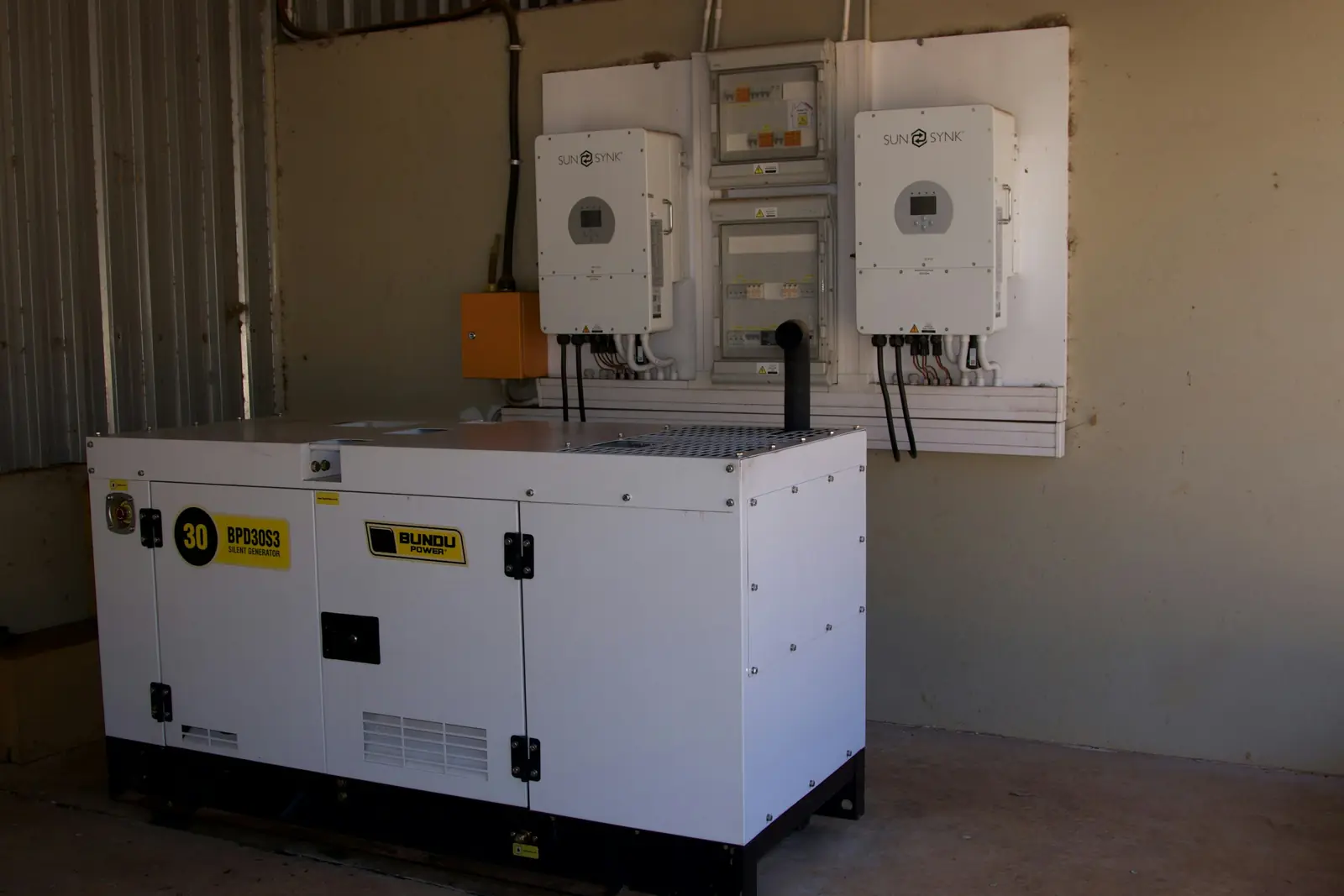
Generators are built to sit still. A standby unit at a condominium, a warehouse, a clinic or a telecom site may run for an hour or so a month during its test, and otherwise it waits. Fuel use is low and irregular, so nobody builds a routine around it, and the tank becomes something that gets checked when someone remembers to.
That is how a power outage turns into a second problem. The generator starts, carries the building for part of the night, and stops, because the tank was lower than anyone thought or the fuel had gone bad. If you are in that situation right now, Emergency Fuel Delivery in Ontario covers what to do first. This article is about making sure you never need it.
Three sets of rules touch the fuel in a standby generator. They come from different places, which is a large part of why they get missed.
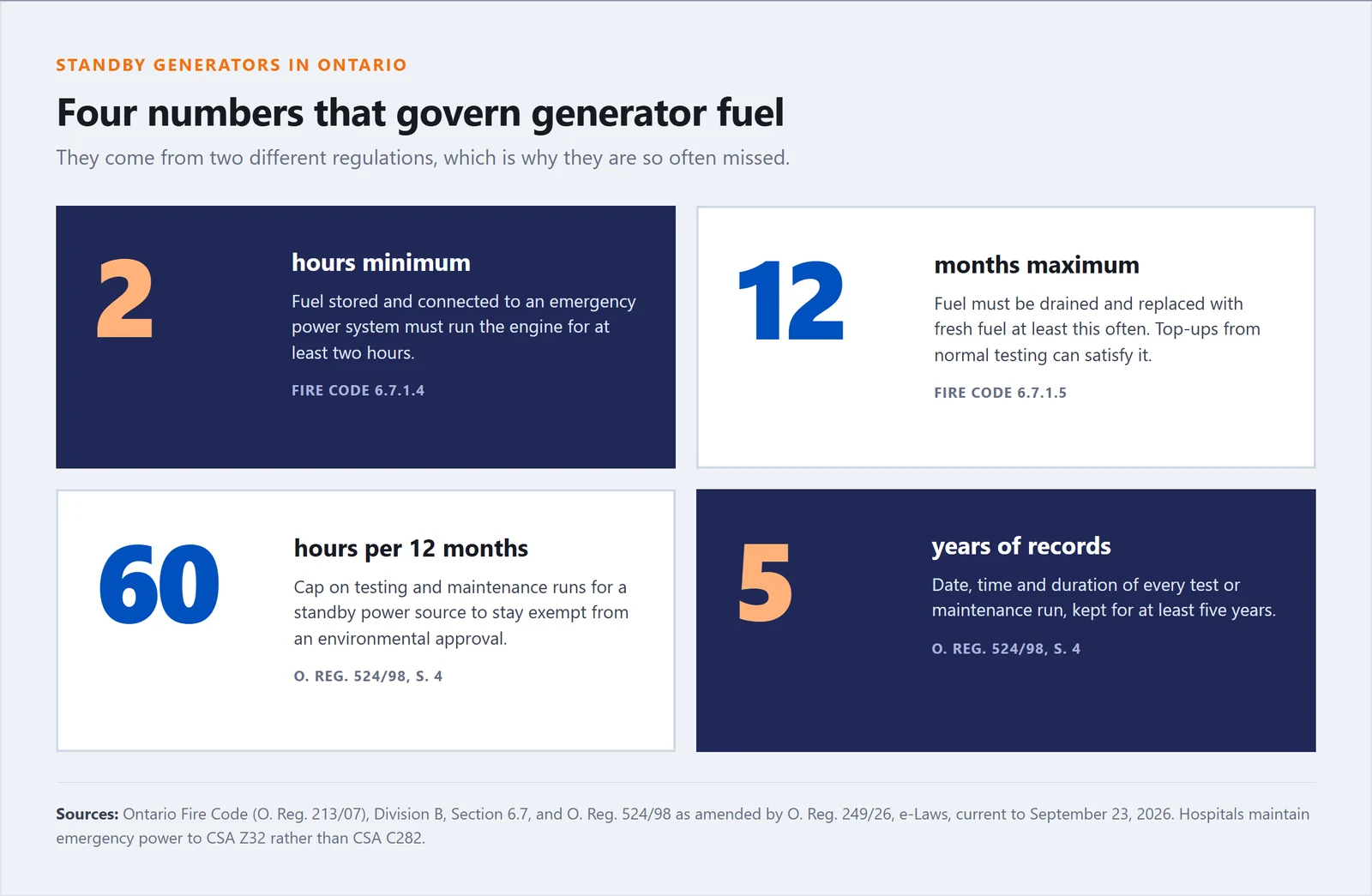
Section 6.7 of the Ontario Fire Code requires emergency power systems to be inspected, tested and maintained in conformance with CSA C282, Emergency Electrical Power Supply for Buildings, with written records kept as that standard requires. Hospitals follow CSA Z32 instead. On fuel specifically, the Fire Code sets two rules. The fuel stored and connected to the emergency power system must be enough to run the engine for at least two hours. And liquid fuel storage tanks must be drained and refilled with fresh fuel at intervals of no more than 12 months, a requirement the code says can be met through replenishment as a result of the normal test program.
Read that second rule carefully. A generator that burns a reasonable amount of fuel in testing, and is topped up with fresh fuel as it goes, can keep its fuel turning over without ever being drained. A generator with a large tank that barely runs will struggle to do that. Agree the approach with whoever maintains your generator, because they sign off the records.
Under Ontario Regulation 524/98, a standby power source is exempt from needing an Environmental Compliance Approval, provided the owner or operator meets a set of conditions. The generator may be used only during power outages or involuntary power reductions, or for testing and maintenance. Testing and maintenance are capped at 60 hours in any 12-month period and must follow the manufacturer's recommendations and generally accepted standards. Every test or maintenance run has to be recorded with its date, time and duration, and the records kept for at least five years.
The 60-hour cap has a knock-on effect on fuel. It limits how much fuel testing can turn over in a year, which is why a large tank on a lightly loaded generator is the setup most likely to fall foul of the fresh-fuel rule.
Stationary generators are one of the uses for which Ontario allows tax-exempt coloured diesel, which is exempt from the 9.0 cent per litre provincial fuel tax. The restriction on coloured fuel applies to vehicles licensed under the Highway Traffic Act, not to a generator on a concrete pad. A generator mounted on a vehicle can use it only when it draws from its own separate fuel tank. If it shares the vehicle's tank, it needs clear diesel.
The Fire Code's two hours is a minimum for emergency power systems, not a planning target. An outage caused by a major storm can last far longer than that, and a delivery during a regional outage competes with every other generator owner calling at the same time. The right level for your site comes from a few numbers you can find yourself:
| What to check | Where to find it | Why it matters |
|---|---|---|
| Fuel burn at your usual load | The generator's specification sheet, which lists fuel consumption at different loads | Turns tank size into hours of run time |
| Usable tank capacity | The tank label or the installer's documents | Not every litre in the tank can be drawn by the engine |
| Current fuel level | The gauge, read at every routine inspection | Tells you when to order, before you need to |
| Age of the fuel | Your delivery records | Drives the Fire Code's 12-month fresh-fuel rule |
| Test hours used this year | Your run log under O. Reg. 524/98 | Limits how much fuel testing can turn over |
The simplest rule of thumb is also the safest one: keep the tank full rather than just above the minimum, and refill after tests rather than waiting for the level to drop.
Diesel does not keep indefinitely. Stored for long periods it can pick up water through condensation, support microbial growth where fuel and water meet, and form sediment that clogs filters at the worst possible moment. That is the reason behind the Fire Code's 12-month rule, and it is why the fuel routine matters as much as the fuel level.
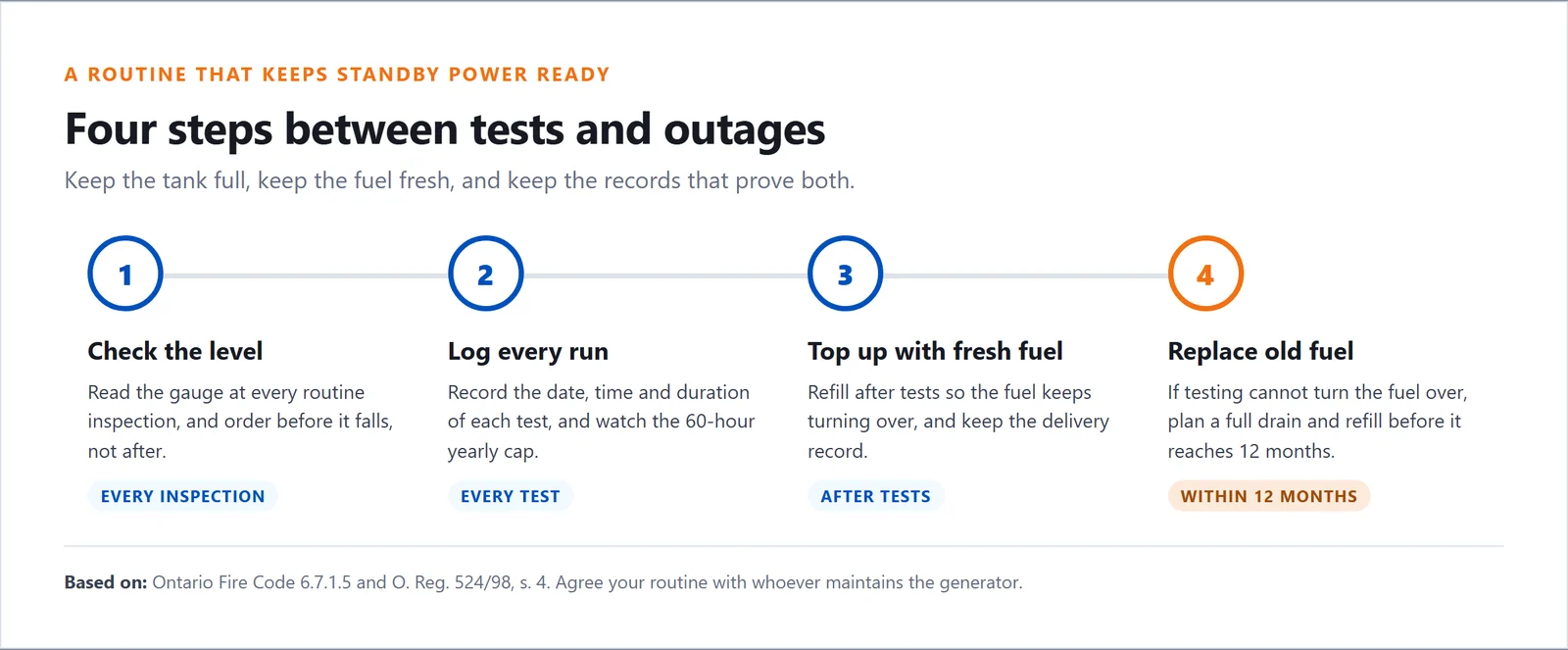
In practice, keeping fuel fresh comes down to a few habits:
If your generator uses selective catalytic reduction to meet emissions limits, it also needs diesel exhaust fluid, and DEF has a shelf life of its own. What is DEF Fluid and Why Does Your Ontario Fleet Need Bulk Delivery? covers how to store it.
The easiest way to stop worrying about generator fuel is to take it off the to-do list. A scheduled delivery account means the tank is topped up on a fixed routine, after tests and ahead of the seasons when outages are most likely, and every fill is recorded with the litres, the date and the unit it went into. That record doubles as the fuel-age history you need for the Fire Code rule.
Refuel Mobile refuels standby generators on the same accounts it runs for fleets and job sites, so one visit can cover generators, equipment and vehicles at the same address, with coloured diesel available where the generator qualifies. Once an account is set up, deliveries can typically be scheduled within 24 to 48 hours, weekdays and weekends. Refuel Mobile treats a request as an emergency when fuel is needed inside 24 hours, and having the account in place already is what makes a fast response possible. For larger site volumes, see our construction and bulk fuel page, and for portable storage beside a temporary generator, our portable on-site units.
Set Up Scheduled Generator Refuelling
Service areas: we deliver across twelve Ontario cities, including Toronto, Kitchener and Guelph. Tell us your site location and we will confirm coverage.

A better way to get fuel.


© Copyright 2026 ReFuel Mobile™. All Rights Reserved.