
A fuel-out stops work immediately and gets expensive by the hour, so the instinct is to search for the fastest possible delivery. The more useful first move is to work out whether you have an emergency or a scheduling failure, because the two have completely different fixes. The single biggest factor in how quickly any Ontario supplier can help is whether you already have an account with them: an existing account moves straight to scheduling, while a new one needs credit terms, site details and a safety review first. Ontario law also restricts where fuel can be dispensed, which rules out some of the places people most want it. Refuel Mobile treats a request as an emergency when fuel is needed inside 24 hours. The genuinely cheap insurance is to open an account before you need one.
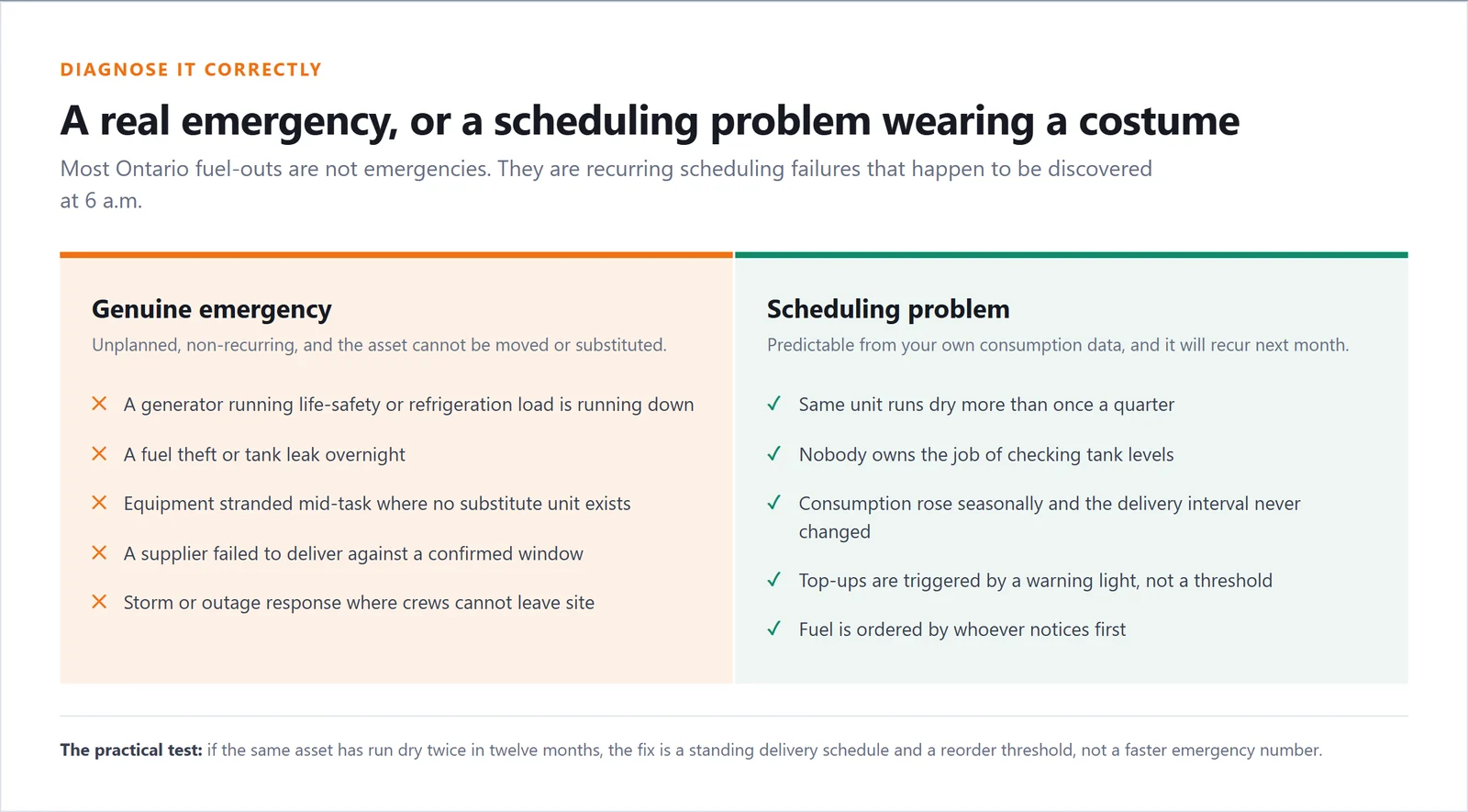
Most fuel-outs in Ontario are not emergencies in any meaningful sense. They are predictable scheduling failures that happen to be discovered at an inconvenient hour. The distinction matters because it changes what you should do in the next ten minutes and what you should change in the next ten days.
A genuine emergency is unplanned, non-recurring, and involves an asset you cannot move or substitute. A generator carrying refrigeration or life-safety load is the clearest example. So is a tank that was full yesterday and is empty this morning, which is a theft or leak problem before it is a fuel problem.
A scheduling problem looks urgent but is visible in your own consumption data weeks ahead. The practical test is simple: if the same asset has run dry twice in twelve months, no emergency number will fix it. A standing delivery schedule and a reorder threshold will.
It is worth knowing where a supplier draws that line, because it decides how your call gets handled. Refuel Mobile treats a request as an emergency when fuel is needed inside 24 hours. There is also no separate emergency number to keep somewhere: after-hours calls go to the same line as everything else.
Understanding the sequence helps you compress it, and helps you tell the difference between a supplier who is being careful and a supplier who is being slow.
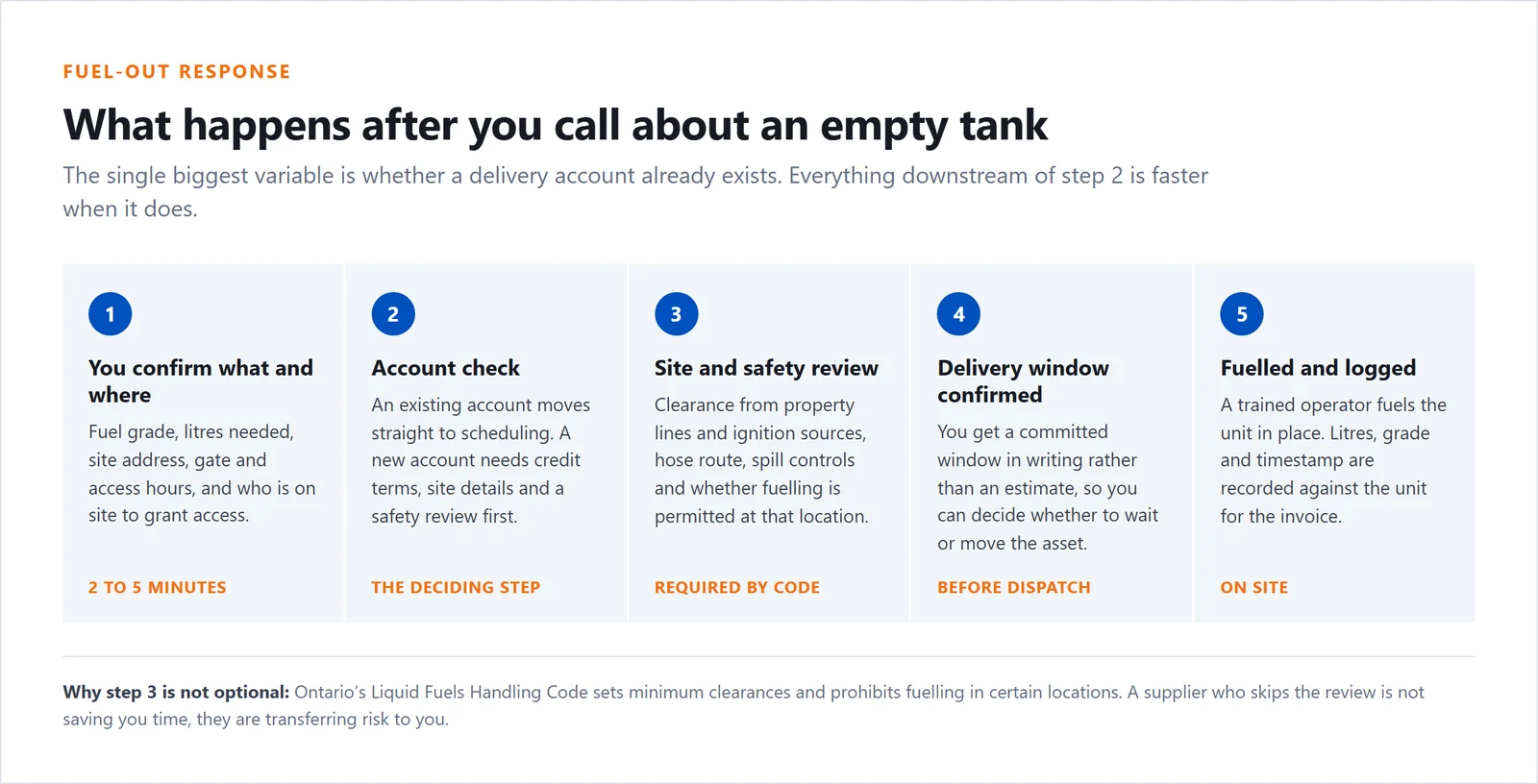
Step two is where most of the variance lives. If you already hold an account, the supplier has your credit terms, your site details and your safety review on file, and the call moves straight to scheduling. If you do not, all of that has to happen before a truck can be dispatched, and none of it can be skipped.
Step three is the one people most often want to skip, and the one that should worry you if a supplier offers to. Clearances, hose routing and whether fuelling is even permitted at that location are set by Ontario's Liquid Fuels Handling Code. A supplier who waves that away is not saving you time, they are transferring risk onto your site and your insurance.

This surprises people during a fuel-out, so it is worth knowing before you are in one. Under the Liquid Fuels Handling Code, mobile fuelling in Ontario:
In practice this means the fastest resolution for a roadside fuel-out is usually to get the vehicle to a location where delivery is lawful, rather than to find a supplier willing to come to the shoulder. Any supplier who agrees to the shoulder without an emergency services request is telling you something about how they operate everywhere else.
Operators bracing for an emergency delivery tend to worry about a premium on the fuel. That is almost never where the money goes. The fuel is a rounding error against what the stoppage costs, which is exactly why the right response is to reduce the frequency of fuel-outs rather than to negotiate harder on the emergency rate.
Work through your own numbers on the five lines below and the picture usually resolves quickly:
Set those against the incremental cost of a delivery outside a scheduled window and the arithmetic is one-sided. It is also why suppliers who quote an aggressive emergency response without asking about your site are worth a second look: the number that matters is not how fast they say they can come, it is whether they will still be able to fuel lawfully when they arrive.
Every one of these shortens the call, and missing any one of them extends it:
If you are calling about a generator, add its runtime remaining and its consumption rate. That converts a vague urgency into a real deadline, and a real deadline is something a dispatcher can plan against.
Fuel-outs are one of the few operational failures that are almost entirely preventable with administration rather than capital.
| Control | What it looks like | What it prevents |
|---|---|---|
| A reorder threshold | A written tank level, set from your own consumption rate and agreed with your supplier, that triggers an order automatically. | Ordering triggered by a warning light or by whoever happens to notice |
| A named owner | One person accountable for tank levels, with a backup named for holidays and absences. | The gap where everyone assumes someone else is watching |
| A standing delivery schedule | Recurring deliveries in an agreed window rather than ad-hoc orders. | The whole category of problem, most of the time |
| Seasonal review | Delivery intervals revisited when consumption changes with the season or the job mix. | Winter idling and summer peak work quietly outrunning a schedule set in spring |
| Consumption logging | Litres recorded by unit so an unusual drop is visible as data, not as a surprise. | Theft and slow leaks going unnoticed until the tank is empty |
The other control, and the cheapest one, is simply having an account open with a supplier before anything goes wrong. It costs nothing to sit dormant and it removes the entire credit-and-onboarding delay from the day you actually need help. You can start that at our contact page, or read how a standing schedule works for fleet operations and on construction and bulk sites.
Set Up a Fuel Account Before You Need One
Service areas: we deliver across twelve Ontario cities, including London, Kitchener, Waterloo. Tell us your yard location and we will confirm coverage.

A better way to get fuel.


© Copyright 2026 ReFuel Mobile™. All Rights Reserved.