
Bulk diesel delivery means a licensed operator brings diesel to your yard or job site and fills your tanks and your equipment where they sit, instead of your people driving to a pump. The pump-side difference between supply models is usually small. What actually moves the number is everything around the fuel: driver hours, out-of-route kilometres, card administration, and whether your off-road equipment can legally run tax-exempt coloured diesel. As of September 2026 Ontario charges 9.0 cents per litre in provincial fuel tax on diesel, the 4.0 cent federal excise tax has returned after the temporary suspension that ended on September 7, 2026, and Ontario does not collect a consumer carbon levy on fuel. If your equipment stays in one place and your people are the ones driving to get fuel, delivery is usually the cheaper model.
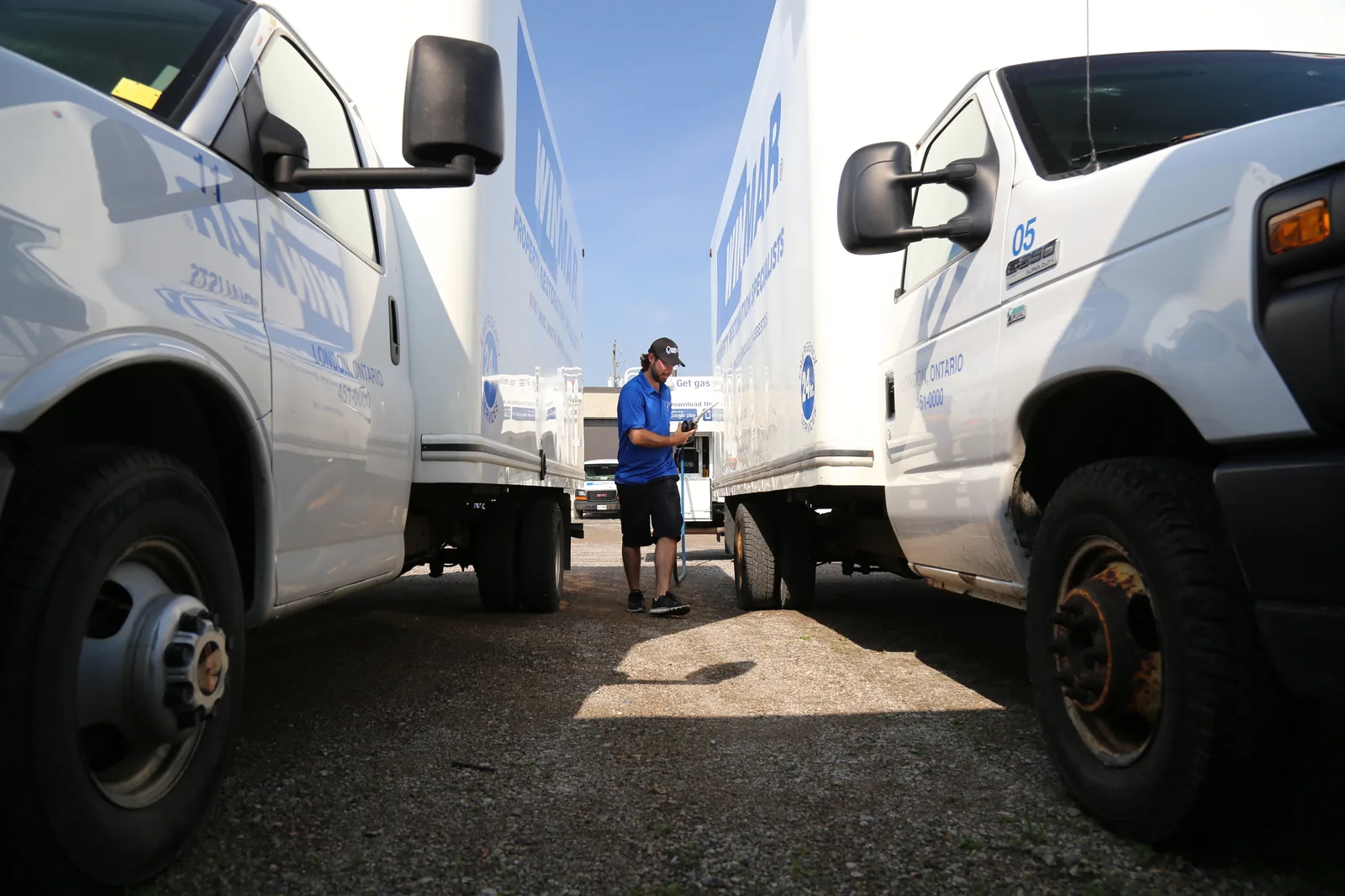
Bulk diesel delivery is the supply of diesel in commercial volumes directly to the place it will be used. A licensed operator arrives with a tank truck and either fills a storage tank on your property or fuels each unit individually, in place, on a schedule you set.
It is worth separating two things that often get called the same thing. Filling a storage tank on your site is a tank delivery. Fuelling individual vehicles and equipment directly from the truck is what Ontario's Liquid Fuels Handling Code calls mobile fuelling, and it is defined as dispensing fuel from a highway tank or mobile refuelling tank into a motor vehicle, which explicitly includes construction and forestry equipment and other off-road vehicles. Most Ontario operations end up using some mix of both.
Both are regulated activities. A supplier operating properly is working under a written safety and emergency response plan, with designated operators who have training records on file, on equipment built to a recognised standard. That is not a marketing detail. It is the difference between a compliant delivery and a liability sitting in your yard.
Before comparing suppliers it helps to know which parts of the price nobody can compete on. Taxes are identical whether you buy at a truck stop, at a cardlock, or from a delivery truck.

Two things are worth flagging for anyone building a 2026 fuel budget. First, the federal excise tax suspension has now ended: it ran from April 20 to September 7, 2026, and 4.0 cents per litre is back on diesel with 10.0 cents back on gasoline. If your current per-litre numbers were captured this summer, they are about to get worse through no fault of your supplier. Second, Ontario is not a federal fuel-charge province for consumer fuels, so the carbon-levy line that appears in some national comparison articles does not apply to diesel bought here.
Everything else in the price is the wholesale rack cost, which moves with the market and is outside anyone's control, plus the supplier's margin, plus HST at 13 percent. The supplier margin is the only genuinely negotiable component, and it is almost always smaller than the operational costs discussed further down this page.
Ontario businesses generally buy diesel one of three ways, and the right answer depends far more on where your equipment lives than on the posted rate.
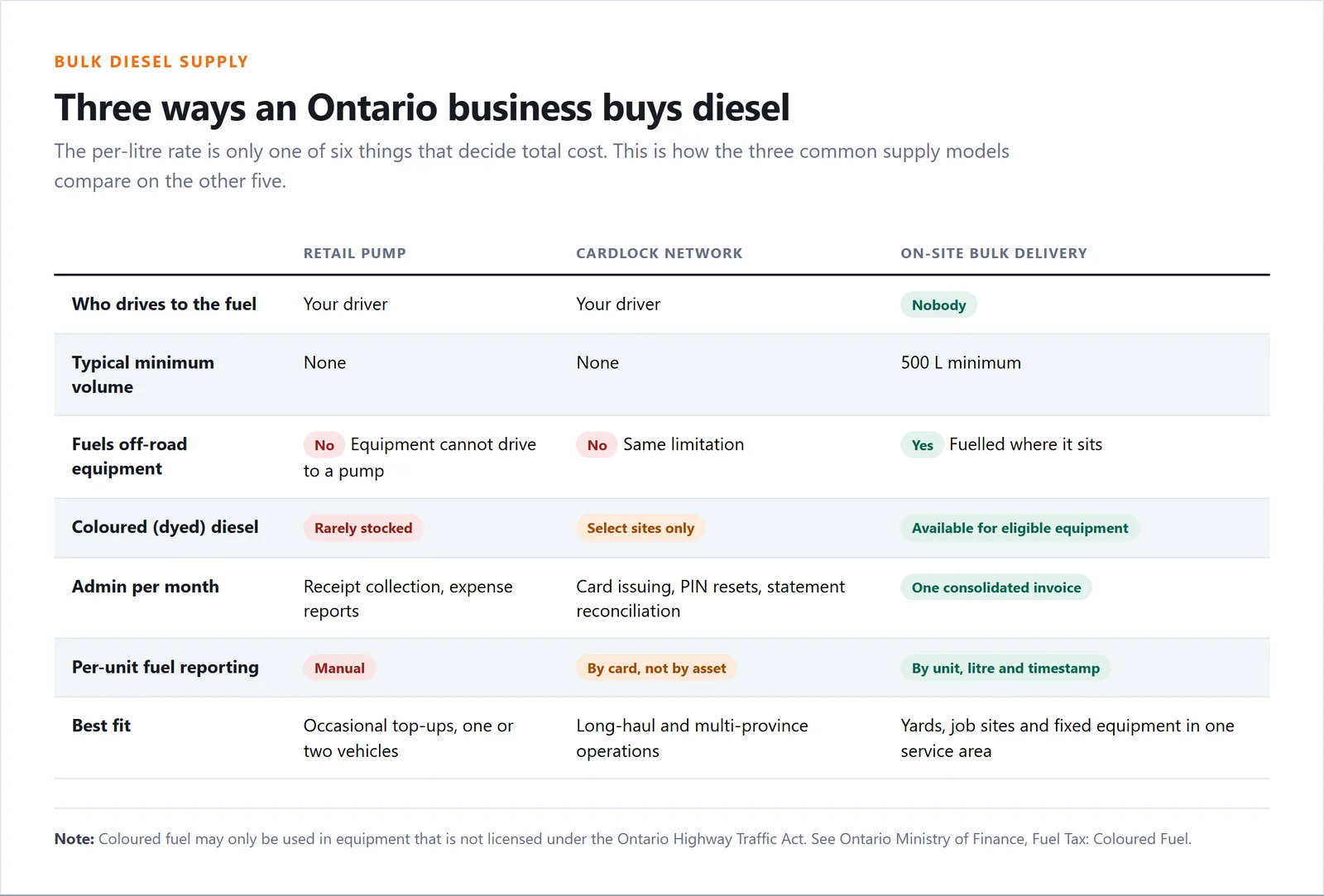
The retail pump works for small operators topping up a truck or two. It carries no minimum, no contract, and no setup. It also cannot fuel anything that is not road-legal, and it puts every litre through an expense-report process.
Cardlock networks are a genuine improvement on retail for road fleets, particularly ones that cross provinces. The trade-off is that Ontario has far fewer cardlock sites than retail stations, so drivers travel further to reach one, and the account brings card issuing, PIN resets, and monthly statement reconciliation with it. We have written a full breakdown of that arithmetic in The Hidden Cost of Cardlock Fuel Cards in Ontario.
On-site bulk delivery removes the trip entirely. Nobody drives to fuel, off-road equipment gets fuelled where it stands, and one invoice replaces a stack of receipts. It suits operations with a yard, a job site, or fixed equipment inside a defined service area. It suits long-haul and multi-province fleets much less well.
Refuel Mobile's own terms sit inside that third model: the minimum delivery is 500 litres, coloured diesel is available for delivery to eligible off-road equipment, and every fill is recorded against the unit number that received it, so the reporting ties back to the asset rather than to a card or a driver.
A fuel invoice shows litres and a rate. It does not show any of the following, all of which are real costs your business absorbs somewhere else on the ledger:
None of these appear on the fuel line of a profit and loss statement. They appear in payroll, in vehicle maintenance, in administrative overhead, and in project schedules. That is exactly why fuel supply decisions get made on the pump rate alone, and exactly why the pump rate is the wrong number to decide on.
Ontario allows tax-exempt coloured fuel, dyed red and carrying a chemical marker, for prescribed non-taxable uses. Coloured diesel is exempt from the 9.0 cents per litre provincial fuel tax. On meaningful volumes that is real money, and a lot of operators running eligible equipment are simply not claiming it.
Coloured fuel may be used in unlicensed farm, construction, forestry and mining equipment, in stationary generators and other electricity generation, in heating, lighting and cooking appliances, in commercial marine vessels, in auxiliary vehicle equipment that has its own separate fuel tank, and in registered railway operations.
The line is bright and it is worth being precise about it: coloured fuel may not be used in any motor vehicle that is licensed under the Highway Traffic Act, no matter who owns it or where it is working. A plated service truck on a closed job site still takes clear diesel. Convictions for improper use carry a fine plus a penalty equal to three times the unpaid tax on a first offence and ten times the unpaid tax on subsequent offences. If you are mixing licensed and unlicensed units, the safe approach is a supplier who can deliver both grades and keeps them recorded separately. Our construction and bulk fuel page covers how that works on an active site.
The decision is usually clear once you answer five questions honestly:
Three or more yes answers and delivery almost always wins on total cost. Mostly no answers, particularly on the last one, and a cardlock program is probably still the right tool.
The process is more straightforward than most operators expect, and the parts that take time are the parts that protect you.
| Step | What happens | What you need to provide |
|---|---|---|
| 1. Volume and grade | Your annual or monthly diesel volume, and whether you need clear, coloured, or both. The minimum delivery is 500 litres. | Twelve months of fuel invoices, or a reasonable estimate |
| 2. Site survey | The operator reviews access, clearances, hose routing and where fuelling can legally take place. | Site address, gate and access hours, a site contact |
| 3. Delivery model | Tank fill, unit-by-unit fuelling, or a mix. This sets the schedule and the equipment used. | Fleet or equipment list, tank capacities if applicable |
| 4. Window and schedule | An agreed recurring window, usually overnight or before shift start, so nothing waits on fuel. | Your shift pattern and when the yard is accessible |
| 5. Reporting and billing | Fills logged by unit number, grade, litres and timestamp, consolidated to one invoice. | Cost-coding requirements: department, route, or job number |
Once an account is active, ordering becomes an exception rather than a routine. The standing schedule does the work, and you are only picking up the phone when something changes.
Get a Bulk Diesel Quote - Tell us your volume and yard location
Service areas: we deliver across twelve Ontario cities, including Toronto, Mississauga, Hamilton. Tell us your yard location and we will confirm coverage.

A better way to get fuel.


© Copyright 2026 ReFuel Mobile™. All Rights Reserved.